Frequently Asked Questions
The most-asked questions about regions of spain.
What exactly are the 'regions of Spain' in this context?
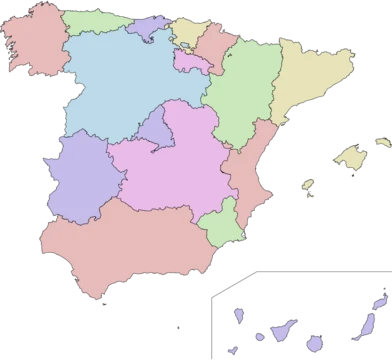
Spain is divided into 17 autonomous communities, each with its own parliament, government, and varying degrees of self-governance, ranging from the Basque Country in the north to the Canary Islands in the Atlantic. They are the primary political and cultural units people refer to when discussing 'regions of Spain.'
How many regions does Spain have, and how does that compare to other countries?
Spain has 17 autonomous communities plus two autonomous cities, Ceuta and Melilla, for a total of 19 first-level divisions. That is more than France's 13 regions but far fewer than the 50 U.S. states.
What is the difference between an autonomous community and a province?
An autonomous community is a political entity with its own statute, legislature, and executive, whereas a province is a purely administrative subdivision for local governance. Each community contains one or more provinces; Andalusia, for instance, is made up of eight.
Which region is the largest and which is the smallest by area?
Andalusia is the largest at roughly 87,660 km², while La Rioja is the smallest at about 5,045 km². The Canary Islands, though geographically distant, form their own community spanning around 7,447 km².
What languages are spoken across Spain's regions?
Spanish (Castilian) is the official language nationwide, but several communities also recognize co-official languages: Catalan in Catalonia, the Valencian Community, and the Balearic Islands; Basque in the Basque Country and Navarre; and Galician in Galicia. This multilingual patchwork is one of the country's most distinctive features.
Where should a newcomer start when exploring Spain's regions?
A practical entry point is mapping the four 'corner' communities—Galicia, Catalonia, the Basque Country, and Andalusia—since they tend to carry the strongest distinct cultural identities. Comparing their statutes of autonomy from there reveals just how much political power each holds.
Which regions enjoy the most political autonomy, and why?
The Basque Country and Navarre collect and manage most of their own taxes under special fiscal arrangements that predate the 1978 Constitution. This gives them a level of self-governance that no other Spanish community currently matches.
What are some notable historical or political moments tied to specific regions?
Catalonia's 2017 independence referendum and its legal aftermath remain among the most discussed events in modern Spanish politics. The 1937 bombing of Guernica in the Basque Country and the labor-movement history of Andalusia are other moments that shaped regional identity profoundly.
Who are some prominent figures associated with Spain's regional identities?
Cultural icons like cellist Pau Casals (Catalonia) and flamenco guitarist Paco de Lucía (Andalusia) are often cited as embodiments of their regions' artistic heritage. On the political side, figures such as Jordi Pujol in Catalonia and Iñigo Urkullu in the Basque Country helped shape modern regional governance.
What makes Spain's regional system unique compared to other European countries?
Spain's 1978 Constitution explicitly frames the nation as a union of 'nationalities and regions,' blending centuries-old local privileges (fueros) with a modern devolved structure. The result is a patchwork where some communities operate almost like small nations while others function as more standard administrative units.