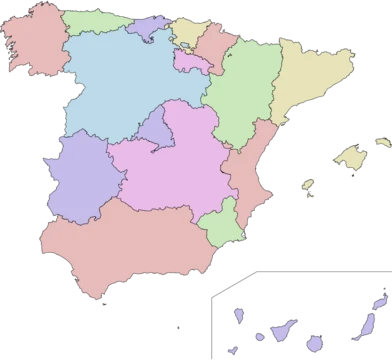
Aragon
Autonomous community in northeastern Spain, historic Kingdom of Aragon.

Aragon is an autonomous community in northeastern Spain, coextensive with the medieval Kingdom of Aragon. It comprises three provinces—Huesca, Zaragoza, and Teruel—with its capital in Zaragoza, and is declared a historic nationality of Spain under its current Statute of Autonomy.
- capital
- Zaragoza
- provinces
- Huesca, Zaragoza, Teruel
- largest_river
- Ebro
Lore & Background
Aragon's terrain ranges from permanent glaciers in the Pyrenees to arid steppes in the central lowlands. The Ebro River, Spain's largest by volume, runs west–east across the region. The region's climate varies from alpine in the high mountains to semi-arid in the Monegros Desert, with the characteristic cierzo wind blowing from northwest to southeast through the Ebro Valley.
Reader's Guide
Aragon's significance lies in its historical role as the core of the medieval Kingdom of Aragon and later the Crown of Aragon, which shaped much of Spain's early expansion. Today it is the fourth-largest autonomous community by area, covering 9.43% of Spain's surface. The region's 33 comarcas preserve a rich geopolitical and cultural heritage spanning pre-Roman, Celtic, Roman, Islamic, and Frankish periods. Aragon's diverse geography—from Pyrenean glaciers to the Ebro valley's steppes—supports varied ecosystems and agriculture, while its rivers, especially the Ebro and its tributaries, are vital to the region's hydrography.
Did You Know?
- The Ebro River, Spain's largest in volume, runs west–east across the entire region.
- The region has 33 comarcas (counties) with history from pre-Roman, Celtic, Roman, Islamic, and Frankish times.
Aragon as a Named Historical Realm
Aragon is identified as one of the historical kingdoms or realms of Spain, a specific category within the broader and multifaceted terminology of Spanish regional identity. The phrase "historical regions of Spain" is not a single, fixed definition; rather, it encompasses several distinct meanings, and Aragon falls under the meaning that refers to any historical kingdom or realm. In this grouping, Aragon is named alongside Castile, León, and Navarre, all presented as examples of what qualifies under this particular definition. This classification is distinct from the constitutional term "nationalities," which refers to autonomous communities granted special status, and it is also separate from the "historical regions" identified in the 1833 territorial division of Spain. Aragon's place in this specific category—rather than in the pre-1936 autonomous communities of Catalonia, Galicia, or the Basque Country—marks it as a historical sovereign territory recognized within the Spanish framework.
The Multi-Layered Terminology of Spanish Regions
The term "historical regions of Spain" functions as an umbrella covering at least four separate categories of regional identity. First, there are the constitutional "nationalities" or "historical nationalities," a legal term applied to autonomous communities granted special status. Second, there are the "historical regions" identified in the text of the 1833 territorial division of Spain. Third, there are the "historical autonomous communities"—specifically Catalonia, Galicia, and the Basque Country—which earned this designation by voting for and approving a Statute of Autonomy before the failed 1936 military coup against the Second Spanish Republic that triggered the Spanish Civil War. Fourth, and the category in which Aragon is placed, there are the historical kingdoms or realms of Spain, with Aragon, Castile, León, and Navarre cited as examples. Aragon's inclusion in this final category distinguishes it from the other three, which are defined by constitutional status, administrative division, or pre-war political action.
Constitutional Distinctions and Aragon's Category
Within the Spanish constitutional and administrative framework, Aragon occupies a specific and distinct position. The constitutional term "nationalities" or "historical nationalities" is reserved for autonomous communities granted special status, a category that does not encompass Aragon in the way it does for certain other regions. Similarly, the "historical autonomous communities" label applies specifically to Catalonia, Galicia, and the Basque Country, regions that voted for and approved a Statute of Autonomy prior to the unsuccessful 1936 military coup against the Second Spanish Republic. Aragon is not listed among these pre-Civil War autonomous communities. Instead, Aragon is classified under the broader and more historical category of kingdoms or realms of Spain, grouped with Castile, León, and Navarre. This distinction matters because it places Aragon's identity in the realm of historical sovereignty rather than in the modern constitutional architecture of autonomous communities with special statutory rights.
Aragon's Standing Among Spain's Named Kingdoms
Aragon is consistently named in the same context as Castile, León, and Navarre, all presented as examples of historical kingdoms or realms of Spain. This consistent grouping indicates that Aragon shares a common historical classification with these other territories, each representing a sovereign entity within the broader Spanish landscape. The fact that Aragon is cited in this specific category—rather than in the constitutional "nationalities" category, the 1833 territorial division category, or the pre-1936 autonomous communities category—highlights the particular nature of its historical identity. While Catalonia, Galicia, and the Basque Country are defined by their pre-Civil War political actions and their current special constitutional status, Aragon's recognition rests on its standing as a historical kingdom. This places Aragon in a category defined by territorial sovereignty and historical legacy, a classification the Spanish framework of regional identity explicitly maintains alongside its more modern administrative and constitutional categories.
Frequently Asked Questions
Who is Aragon?
Aragon is an autonomous community in northeastern Spain that descends directly from the medieval Kingdom of Aragon. It is made up of three provinces—Huesca, Zaragoza, and Teruel—and is officially recognized as a historic nationality within Spain.
What are Aragon's 'territories' (provinces) and where's its capital?
Aragon is split into three provinces: Huesca to the north, Zaragoza in the center, and Teruel to the south. Zaragoza doubles as the capital city of the whole community.
Why is Aragon considered special compared to other Spanish regions?
Aragon is declared a historic nationality under its current Statute of Autonomy, a status that reflects its long-standing identity as a former kingdom. That medieval heritage gives it a distinct cultural and political character within modern Spain.
More in Regions Of Spain 1-21
Spotted an error? Know more?
This is a living reference — every entry is fact-audited, and reader corrections feed straight into our audit queue. Suggest an edit · See this site's audit record