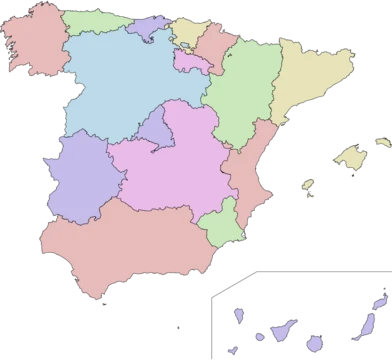
Asturias
Autonomous community in northwestern Spain, cradle of the Reconquista.

Asturias, officially the Principality of Asturias, is an autonomous community in northwestern Spain, coextensive with the province of Asturias. It contains some of the territory that was part of the larger Kingdom of Asturias in the Middle Ages and is known for its mountainous setting, lush vegetation, and maritime climate, forming part of Green Spain. With a population of about 1 million, it is one of the least populous autonomous communities of Spain.
- Capital
- Oviedo
- Largest city
- Gijón
- Population
- About 1 million
- Established as autonomous community
- 30 December 1981
- Bordering regions
- Cantabria (east), León (south), Lugo (west), Cantabrian Sea (north)
- Notable historical role
- Cradle of the Reconquista
Lore & Background
Asturias was inhabited first by Neanderthals, with cave paintings from the Upper Paleolithic in the eastern area. In the Mesolithic, the Asturiense culture developed, and during the Bronze Age, megaliths and tumuli were constructed. In the Iron Age, Celtic peoples known as the Astures populated the area with fortified hill towns, and their influence persists in place names. The Romans under Augustus conquered the region between 29 and 19 BC, and after the Cantabrian Wars the area was effectively incorporated into the Roman Empire.
Reader's Guide
Asturias holds significance as a historical refuge and birthplace of the Reconquista, the centuries-long Christian effort to reclaim the Iberian Peninsula from Islamic rule. Its mountainous terrain allowed it to resist Roman, Visigoth, and Moorish conquest, preserving Christian nobility and culture. The region's role in the Spanish Enlightenment, its early resistance in the Napoleonic Wars, and its industrial development in the 19th and 20th centuries mark it as a key contributor to Spanish history. After Franco's death, Asturias regained its name and became an autonomous community in 1981, with comprehensive competencies in health, education, and environmental protection. Its legacy includes the title Prince of Asturias for the Spanish heir, and its cultural and natural heritage as part of Green Spain.
A Green Corner of the Iberian Peninsula
Asturias occupies a compact stretch of northwestern Spain, its territory coextensive with the province of the same name and divided into eight comarcas. To the east it meets Cantabria, to the south the Castilian province of León, to the west Galicia's Lugo, and to the north the open waters of the Cantabrian Sea. With roughly one million residents, it ranks among the least populous autonomous communities in the country. The landscape is defined by mountains draped in dense, lush vegetation, earning the region a place in what Spaniards call Green Spain. Its maritime climate brings generous rainfall and comparatively little sunshine, keeping temperatures in the lower twenties Celsius through most of the year. The surrounding peaks block hot southerly winds, making heat waves a rarity, while winters stay notably mild for the latitude, particularly along the coast. Three cities anchor the population: Oviedo, the administrative capital; Gijón, the largest city and principal seaport; and Avilés, long associated with heavy industry.
From Cave Paintings to the Cradle of the Reconquista
The human story in Asturias stretches back to Homo erectus and Neanderthal communities, with Paleolithic cave art dotting the eastern reaches of the territory. A distinct Mesolithic culture, the Asturiense, took root before the Bronze Age introduced megaliths and burial tumuli. By the Iron Age, Celtic-speaking peoples called the Astures—organized into tribes such as the Luggones and the Pesicos—had spread fortified hill towns across the region, and their linguistic fingerprints still echo in local river and mountain names. Roman legions under Augustus subdued the Astures between 29 and 19 BC, yet the mountainous terrain ensured they were never fully absorbed. During the Germanic upheavals of the fifth century, the highlands resisted Suebi and Visigoth incursions. When the Moors swept into Iberia in the eighth century, the northern coast proved impregnable and fell outside Islamic rule.
Coal, Corn, and the Return of the Indianos
The eighteenth century placed Asturias at the heart of the Spanish Enlightenment: the Galician thinker Benito de Feijóo settled at the Benedictine Monastery of San Vicente de Oviedo, and the polymath reformer Gaspar Melchor de Jovellanos was born in the seaside town of Gijón. At the same time, waves of Asturians emigrated to Argentina, Uruguay, Puerto Rico, Cuba, and Mexico. Those who built fortunes abroad returned home as the Indianos, and their wealth reshaped the landscape: grand modernista villas now dot the countryside, alongside free schools and public libraries funded by these families. The arrival of American corn in the seventeenth century had already doubled the population from its sixteenth-century peak of one hundred thousand. Asturias also supplied the Spanish court with high-ranking aristocrats and played a significant role in the colonisation of the Americas, a connection that wove the region into the broader imperial project.
A Region of Defiance: From Napoleon to the Civil War
Asturias has a long tradition of resisting outside domination. Riots erupted in Oviedo, and by 25 May the local government formally declared war, calling eighteen thousand men to arms. For a month a Popular Front Committee governed southern Asturias, workers' committees sprang up across the region, and an anarcho-syndicalist defense committee seized power in Oviedo. The central government dispatched troops from Spanish Morocco under a then-unknown officer named Francisco Franco Bahamonde, deploying the Spanish Legion and Moroccan units with tactics normally reserved for overseas colonies. The ferocious suppression that followed left a deep scar. Yet Asturias remained loyal to the republican cause during the Civil War, and the Battle of El Mazuco became legendary as an extraordinary defence fought in extreme mountainous terrain before Franco's forces eventually took control.
Frequently Asked Questions
What is Asturias and where is it located?
Asturias is an autonomous community in northwestern Spain that occupies the same territory as the province of Asturias. It stretches along the Cantabrian Sea coast in the north, with Cantabria to the east, León to the south, and Lugo to the west.
Why is Asturias historically significant?
Asturias is widely regarded as the cradle of the Reconquista, since the medieval Kingdom of Asturias was the first Christian polity to hold ground against Moorish expansion on the Iberian Peninsula. That legacy gives the region a foundational role in Spanish national history.
How big is Asturias and what are its main cities?
With roughly one million inhabitants, it ranks among the least populated autonomous communities in Spain. Oviedo serves as the capital, while Gijón is the largest city.
When did Asturias gain its autonomous status?
Asturias was formally established as an autonomous community on 30 December 1981, receiving its own regional government within the framework of the Spanish state.
More in Regions Of Spain 1-21
Spotted an error? Know more?
This is a living reference — every entry is fact-audited, and reader corrections feed straight into our audit queue. Suggest an edit · See this site's audit record