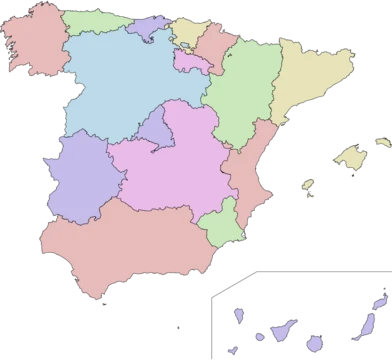
Galicia (Spain)
Northwest Spanish region with Celtic roots and Atlantic coast.

Galicia is an autonomous community of Spain and a historic nationality under Spanish law, located in the northwest Iberian Peninsula. It includes the provinces of A Coruña, Lugo, Ourense, and Pontevedra, and is bordered by Portugal to the south, the Atlantic Ocean to the west, and the Cantabrian Sea to the north.
- gdp_2018
- €62.5 billion
Lore & Background
The area now called Galicia was first inhabited during the Middle Paleolithic period, with evidence found in the Eirós Cave.
Reader's Guide
Galicia's significance lies in its preservation of a distinct Celtic-derived identity and language within Spain, alongside a long history of self-governance. During the Middle Ages, the kingdom of Galicia was often leagued with Leon and Castile but maintained its own legal and customary practices. From the 16th century, the Cortes or Junta of the Kingdom of Galicia represented the kingdom until its dissolution in 1833. The 19th and 20th centuries saw growing demands for self-government, leading to the Statute of Autonomy of 1936, which was frustrated by Franco's dictatorship. After democracy was restored, the Statute of Autonomy of 1981 was approved, providing Galicia with self-government. Today, Galicia is characterized by a hilly interior, a coastline of rias and beaches, and an economy historically based on farming and fishing, now industrialized. Its urban network lacks a single dominant metropolis, with seven main cities including the political capital Santiago de Compostela.
Did You Know?
- Galicia's name derives from the Gallaeci, a Celtic people who lived north of the Douro River during the last millennium BC.
- The Atlantic Islands of Galicia National Park includes the Cíes Islands, Ons, Sálvora, and Cortegada Island.
- The oldest human presence in Galicia is from the Middle Paleolithic, found in the Eirós Cave.
Coastal Geography & Natural Setting
Galicia sits in the northwest corner of the Iberian Peninsula, where the Atlantic Ocean meets the Cantabrian Sea to the north. Its borders touch Portugal to the south and the Spanish regions of Castile and León and Asturias to the east. The shore alternates between deep rias and open beaches, while the interior rises into hilly terrain with mountain ranges reaching 2,000 meters in the east and south. Scattered across the waters are the Cíes Islands, Ons, Sálvora, and Cortegada Island, which together form the Atlantic Islands of Galicia National Park. The climate is temperate and rainy, with drier summers, a pattern that has historically favored animal husbandry and farming as the backbone of local wealth.
Ancient Roots & the Mystery of the Name
The name Galicia traces back to the Gallaeci, or Callaeci in Latin, a Celtic tribe dwelling north of the Douro River during the last millennium BC. These were the first group in the region to aid the Lusitanians against Roman invaders, and the Romans eventually extended their label to all neighboring tribes sharing the same language and way of life. The area was formally incorporated into the Roman Empire after the Cantabrian Wars ended in 19 BC and became a Roman province in the 3rd century AD. The etymology of the name has fascinated scholars for centuries. Isidore of Seville, writing in the 7th century, linked it to the Greek word for milk, suggesting fair skin. More recent proposals derive it from Proto-Indo-European roots meaning the hill people or the forest people. Linguist Francesco Benozzo has offered another reading: the root gall- or kall- appears across Celtic languages meaning stone or rock, making the Callaeci the stone people—a fitting title for builders of the megaliths and stone formations still scattered across the landscape.
From Suebi Kingdom to Modern Autonomy
During the Middle Ages, Galicia occasionally had its own kings but was mostly leagued to León and later Castile, while preserving distinct legal customs and culture. From the 13th century, Castilian kings appointed an Adiantado-mór, a role that evolved into the Governor and Captain General by the late 15th century. The Cortes or Junta of the Kingdom of Galicia served as the kingdom's representative assembly from the 16th century until it was forcibly dissolved in 1833, when the territory was split into four provinces with no legal mutual links. Centuries of growing demand for self-government and cultural recognition culminated in the 1936 Statute of Autonomy, quickly crushed by Franco's coup. Democracy's return brought the 1981 Statute, approved by referendum and still in force today.
Polycentric Cities, Economy & Bilingual Life
Unlike many Spanish regions, Galicia has no single dominant metropolis. Instead, its urban network rests on seven main cities: the four provincial capitals (A Coruña, Pontevedra, Ourense, Lugo), the political capital Santiago de Compostela, and the industrial centers Vigo and Ferrol. Population clusters along the northern coast from Ferrol to A Coruña and in the Rías Baixas southwest, while smaller communities orbit Lugo and Ourense in the interior. For most of its history, the economy centered on farming, animal husbandry, and fishing, with shipbuilding and food processing as secondary pillars. Industrialization only gained momentum after the mid-20th century. Linguistically, Galicia is distinctive: both Galician and Spanish (Castilian) hold official status.
Frequently Asked Questions
What is Galicia (Spain)?
Galicia is an autonomous community and historic nationality in the northwest corner of the Iberian Peninsula, recognized under Spanish law as a distinct cultural entity. It is defined by its Celtic heritage, Atlantic coastline, and a unique Romance language that sets it apart from the rest of Spain.
Does Galicia (Spain) have its own language?
Yes. Galician is a Romance language with notable Celtic linguistic traces, and it holds co-official status alongside Spanish within the region. It is one of the few surviving Celtic-influenced tongues on the European mainland.
Where exactly is Galicia (Spain) located?
It sits at the far northwest tip of Spain, sharing a land border with Portugal to the south, the Atlantic Ocean to the west, and the Cantabrian Sea to the north. This triple-water geography gives it a distinctly maritime and temperate character compared to interior Spanish regions.
More in Regions Of Spain 1-21
Spotted an error? Know more?
This is a living reference — every entry is fact-audited, and reader corrections feed straight into our audit queue. Suggest an edit · See this site's audit record