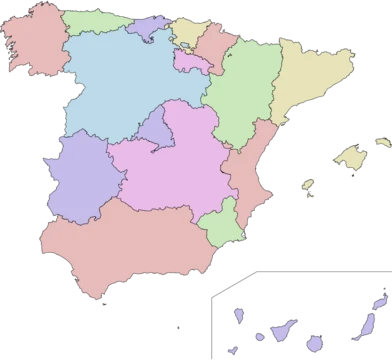
Cantabria
Historic community in northern Spain with ancient cave art.

Cantabria is an autonomous community and province in northern Spain, with Santander as its capital. It is designated a historic community in its current Statute of Autonomy. Cantabria belongs to Green Spain, a strip of land between the Bay of Biscay and the Cantabrian Mountains known for lush vegetation due to a wet, temperate oceanic climate.
- Capital
- Santander
- Area
- Part of Green Spain, between Bay of Biscay and Cantabrian Mountains
- Climate
- Wet and temperate oceanic, average annual precipitation about 1,200 mm
- Autonomy Statute Approved
- 30 December 1981
Lore & Background
The Cantabri were used as mercenaries in conflicts including the Second Punic War. The Cantabrian Wars began in 29 BC; they were defeated by Agrippa in 19 BC but revolted again under Tiberius and were never entirely subdued. In older geographers, Cantabria referred to an expansive country bounded by the Cantabrian Sea, the Sella valley, Peña Amaya, and the Aguera River, including parts of Asturias, Santander, Biscay, and Guipuzcoa. After the Roman conquest, it was restricted to Santander and eastern Asturias, forming part of Hispania Tarraconensis. Principal tribes included the Pleutauri, Varduli, Autrigones, Tuisi, and Conisci or Concaui. The largest city was Juliobriga, and local mountains were exploited for lead mines.
Reader's Guide
Cantabria's significance lies in its deep historical roots, from Upper Paleolithic cave paintings to its role in Roman and medieval times. The region's name, of uncertain Celtic origin, may mean 'people who live in the rocks' or 'coastal district.' During the late Middle Ages to early 19th century, the name also referred to the Basque territory, especially Biscay. The Organic Law of the Autonomy Statute of Cantabria was approved on 30 December 1981, granting self-government. Cantabria's archaeological sites, particularly Altamira, underscore its importance in human prehistory. Its location in Green Spain, with a wet climate and lush vegetation, distinguishes it geographically. The region's history includes independence from Visigoths, participation in the Reconquista, and later unification efforts in the 18th century. The legacy of Cantabria is preserved in its institutions and cultural identity.
Did You Know?
- The name Cantabria may derive from Celtic roots meaning 'rock' or 'edge,' possibly referring to 'people who live in the rocks' or 'coastal district.'
- The Cantabrian Wars began in 29 BC, and the Cantabri were never entirely subdued by Rome.
The Cantabri in the Ancient World
Their involvement in the Second Punic War is attested by both Silius Italicus and Horace, and when the Roman general C. Hostilius Mancinus found Cantabri and Vaccaei warriors among his auxiliaries during the siege of Numantia, he chose to withdraw rather than continue. The Cantabrian Wars, which erupted in 29 BC, saw the region's inhabitants put up fierce resistance; Agrippa crushed them with heavy casualties in 19 BC, yet they rose again under Tiberius and were never fully subdued. The principal tribes included the Pleutauri, Varduli, Autrigones, Tuisi, and the Conisci, the latter notorious for drinking their horses' blood. The largest settlement was Juliobriga, and the surrounding mountains yielded lead ore.
Prehistoric Heritage and the Caves of Green Spain
The archaeological record of Cantabria stretches back to the Lower Paleolithic, when the earliest traces of human occupation appeared in the region's caves and valleys. By the Upper Paleolithic, the landscape had become a canvas for some of the most remarkable artistic achievements of prehistoric humanity. Its discovery and subsequent recognition led UNESCO to declare Altamira, together with nine other Cantabrian caves, as World Heritage Sites. This designation underscores the extraordinary density of prehistoric artistic activity concentrated in this relatively small stretch of northern Spain. The lush, mountainous terrain of Green Spain, shaped by Atlantic winds and heavy rainfall averaging around 1,200 millimetres per year, provided the sheltered grottos and deep valleys where these ancient communities found refuge and inspiration. The fact that ten separate caves in a single autonomous community achieved such a distinction speaks to the depth and breadth of human creative expression that took root here tens of thousands of years before written history began.
A Name in Motion: Etymology and Shifting Identity
The etymology of Cantabria has puzzled scholars for centuries. Isidore of Seville, Julio Caro Baroja, Aureliano Fernández-Guerra, and Adolf Schulten all proposed theories, yet no single explanation has achieved consensus. One widely cited derivation traces the root cant- to a Celtic word for 'rock' or 'rocky,' with the suffix -abr common across Celtic-speaking regions, yielding a meaning like 'people who live in the rocks' or 'highlanders'—a fitting description for steep, mountainous terrain. An alternative reading links the name to the Celtic root kant or cant, meaning 'edge' or 'rim,' suggesting 'coastal district' or 'land on the edge.' This second interpretation shares a probable linguistic ancestor with the English county of Kent and the city of Canterbury. The name's geographic scope shifted dramatically over the centuries: in antiquity it encompassed parts of Asturias, Santander, Biscay, and Guipuzcoa; after the Roman conquest it narrowed to Santander and eastern Asturias; in late medieval and early modern literature it came to denote the Basque Country, particularly the lordship of Biscay; and only during the Spanish liberal regimes of the nineteenth century did it settle firmly onto the modern province of Santander.
From Medieval Independence to Modern Autonomy
The Albendense Chronicle still names Alfonso I as 'the son of Peter, the duke of Cantabria.' After this era, the name largely vanished from administrative records, supplanted by the comarcas of Asturias de Santillana, Asturias de Trasmiera, and Asturias de Laredo. Political identity was rebuilt around the Hermandad de las Cuatro Villas—Santander, Laredo, Castro Urdiales, and San Vicente de la Barquera—and the wider Hermandad de las Marismas. Full self-government arrived with the Autonomy Statute of 30 December 1981, designating Cantabria a comunidad histórica.
Frequently Asked Questions
Who is Cantabria?
Cantabria is an autonomous community and province tucked into northern Spain along the Cantabrian Sea, with Santander as its capital city. It is officially designated a historic community under its current Statute of Autonomy.
What is Cantabria's climate and geography like?
The region sits within Green Spain, a verdant strip between the Bay of Biscay and the Cantabrian Mountains. A wet, temperate oceanic climate delivers roughly 1,200 mm of annual rainfall, keeping the landscape lush year-round.
When did Cantabria gain its autonomous status?
Cantabria's Statute of Autonomy was approved on 30 December 1981, formally establishing the region's self-governing political framework within Spain.
More in Regions Of Spain 1-21
Spotted an error? Know more?
This is a living reference — every entry is fact-audited, and reader corrections feed straight into our audit queue. Suggest an edit · See this site's audit record