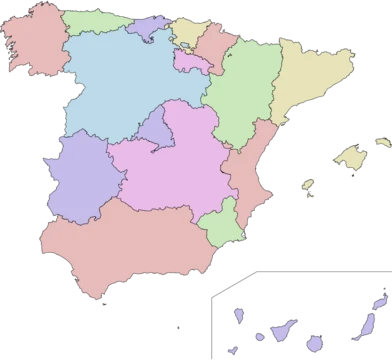
Castile and León
Largest autonomous community in Spain, with a de facto capital in Valladolid.

Castile and León is an autonomous community of Spain, created in 1983 by grouping the provinces of León, Zamora, Salamanca, Ávila, Burgos, Palencia, Segovia, Soria, and Valladolid. While a capital has not been explicitly declared, the seats of executive and legislative powers are set in Valladolid by law, making that city the de facto regional capital. The region is landlocked in the northwest of the Iberian Peninsula, bordered by Portugal and several Spanish autonomous communities, and is chiefly composed of the northern half of the Inner Plateau, drained by the Douro River.
- Population
- ~2.4 million
- Population Density
- ~25/km²
- Created
- 1983
- De Facto Capital
- Valladolid
- UNESCO World Heritage Sites
- 11
- Quality of Government Index
- Worst in Spain
Lore & Background
The region contains eleven World Heritage Sites, tying with Lombardia in Italy for the most UNESCO World Heritage Sites. The region is strongly affected by population ageing and has the worst quality of government index in Spain. Prehistoric inhabitants are evidenced by findings in the Atapuerca Mountains, including remains of Homo heidelbergensis. Before Roman arrival, Celtic peoples such as the Vaccaei and Vettones occupied the area. The Roman conquest included the siege of Numantia, and Roman works like the Aqueduct of Segovia remain.
Reader's Guide
The Camino de Santiago pilgrimage route, running through the northern part of the region, spread European cultural innovations. Today, the region's eleven UNESCO World Heritage Sites, including the Aqueduct of Segovia and the Atapuerca archaeological site, underscore its cultural and historical legacy. However, it faces challenges of population ageing and the lowest quality of government index in Spain.
Did You Know?
- The region contains eleven UNESCO World Heritage Sites, tied with Lombardia in Italy for the most.
- The Atapuerca Mountains in the region yielded remains of Homo heidelbergensis.
A Queen in Her Own Right
Urraca of León, Castile, and Galicia holds a singular place in medieval European history as the first queen to govern a realm in her own right. She did not merely accept the title of queen; she claimed the far grander designation of suo jure Empress of All Spain and Empress of All Galicia, asserting sovereignty that derived from her own bloodline rather than from any husband. Her earliest surviving royal diploma, issued just a day after her father's funeral, styled her 'queen of whole Spain,' and it was witnessed by prominent Leonese, Castilian, and Galician aristocrats alongside twelve bishops—a clear signal that the elite of her realm recognized her as a lawful monarch.
A Throne Forged in Loss
Urraca's path to the crown was neither smooth nor certain. As the sole child of Alfonso VI and Constance of Burgundy, she seemed destined to inherit, yet her father's later relationships repeatedly threatened that claim. His sudden death transformed Urraca into her father's sole heir.
Marriages as Statecraft
Urraca's two marriages were deeply entangled with the political survival of her family's realms. Raymond, a descendant of the County of Burgundy's rulers, brought connections to the powerful Cluny network. Yet the marriage was not an equal partnership: Raymond was listed first in nearly all documents issued during their joint rule, and Urraca remained under his legal tutelage as a woman. Together they witnessed charters for the repopulation of Ávila, Segovia, Salamanca, and Zamora, but the administrative hierarchy was clear. Her second marriage, to Alfonso I of Aragon and Navarre, was reportedly arranged over her objections by Leonese nobles who believed a woman could not defend the kingdom against the Almoravids, and they labeled him 'the bloodthirsty and cruel Aragonese tyrant.'
A Child of Cluny and the Crown
Her mother's family was deeply woven into the religious and political networks of medieval Europe: Constance was closely related to the French royal house, and the influential Burgundian abbot Hugh of Cluny was her maternal uncle. The very marriage that produced Urraca carried a papal condition—Pope Gregory VII confirmed it only after Alfonso agreed to replace the traditional Mozarabic liturgy in his kingdoms with the Roman Rite. As her parents' only child, Urraca's early years are sparsely documented, but her own royal diplomas name two clergymen, Presbyter Pedro and Domingo Falcóniz, as her tutors. Her paternal aunt Elvira was clearly a close figure in her life, later serving as guardian of Urraca's daughter Sancha Raimúndez. A later chronicler, Rodrigo Jiménez de Rada, claimed that the powerful aristocrat Pedro Ansúrez and his wife Elo Alfónsez raised Urraca in their household, though no contemporary document corroborates this account.
Frequently Asked Questions
What are Castile and León's powers/role?
The region holds the distinction of containing 11 UNESCO World Heritage Sites, the most of any Spanish autonomous community. Its role is defined by its vast, sparsely populated territory—roughly 25 people per square kilometre—and its position as a landlocked border area touching Portugal.
How does Castile and León's story end?
As a living political entity rather than a finished narrative, Castile and León has no definitive ending; it continues to function as a self-governing community within Spain's constitutional framework. Its ongoing arc is shaped in part by demographic challenges reflected in its low population density of about 25 inhabitants per square kilometre.
Why is Castile and León important?
It accounts for the greatest land area of any Spanish region, giving it disproportionate weight in national land-use and agricultural policy. Its eleven UNESCO sites also anchor it as one of the country's most culturally significant territories.
Where is Castile and León's headquarters?
Valladolid serves as the de facto capital, hosting both the regional executive and legislative bodies by law, even though no city has been formally declared the official capital. The region sits landlocked in the northwest of the Iberian Peninsula, bordering Portugal and several other Spanish communities.
More in Regions Of Spain 1-21
Spotted an error? Know more?
This is a living reference — every entry is fact-audited, and reader corrections feed straight into our audit queue. Suggest an edit · See this site's audit record