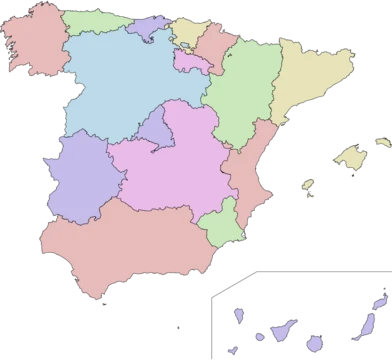
Catalonia
An autonomous community in northeastern Spain with a distinct history and language.

Catalonia is an autonomous community of Spain, designated as a nationality by its Statute of Autonomy. Its territory is situated on the northeast of the Iberian Peninsula, to the south of the Pyrenees mountain range. The capital and largest city, Barcelona, is the second-most populous municipality in Spain and the fifth-most populous urban area in the European Union. Modern-day Catalonia comprises most of the medieval and early modern Principality of Catalonia, with the remainder of the northern area now part of France's Pyrénées-Orientales.
- type
- Autonomous community of Spain
- capital
- Barcelona
- official_languages
- Catalan, Spanish, Aranese dialect of Occitan
- administrative_divisions
- Four provinces or eight vegueries, divided into 43 comarques
- historical_entity
- Principality of Catalonia (medieval and early modern)
Lore & Background
Within the Crown, Barcelona and the other Catalan counties merged into the Principality of Catalonia, with its distinct institutional system, such as Courts, Generalitat, and Constitutions, being the base and promoter for the Crown's Mediterranean trade and expansionism. Catalan literature flourished. Catalan as a language of government and literature was eclipsed by Spanish.
Reader's Guide
Catalonia's significance lies in its long history as a distinct political and cultural entity within Spain, with its own language, institutions, and legal traditions. The Second Spanish Republic restored self-governance, but the Francoist dictatorship abolished it and banned Catalan. After the Spanish transition to democracy, self-government was reestablished, and Catalonia became one of Spain's most economically dynamic communities. In the 2010s–2020s, growing support for Catalan independence led to a unilateral declaration of independence in 2017, which was deemed unconstitutional, resulting in direct rule by the Spanish state and legal actions against Catalan leaders. The name 'Catalonia' itself has disputed origins, with theories ranging from 'Land of the Goths' to Arabic 'qattālūn' meaning 'killer'. The region's official languages include Catalan, Spanish, and Aranese Occitan, with Catalan Sign Language recognized since 2010.
Did You Know?
- The name 'Catalonia' may derive from 'Gothia Launia' ('Land of the Goths') or from the Arabic 'qattālūn' ('killers').
- The Catalan Sign Language has been a legal medium of instruction alongside official languages since 3 June 2010.
- Barcelona is the second-most populous municipality in Spain and the fifth-most populous urban area in the European Union.
Constitutional Ambiguity and the Question of Nationhood
The 1978 Spanish Constitution represents a carefully negotiated compromise between the centralist legacy inherited from Franco's regime and the self-governing aspirations of Catalonia, the Basque Country, and Galicia. The document proclaims a single, indivisible homeland for all Spaniards while simultaneously acknowledging the claims of what it calls "historic nationalities"—a term that was never formally defined in the text. Although the constitution's drafters explicitly had these three territories in mind, no autonomous community is named, leaving the legal status of each deliberately open to interpretation. The word "nationality" entered Spanish jurisprudence for the first time in this text, and while several of the constitution's authors later insisted it was synonymous with "nation," the Constitutional Court has firmly rejected that reading. This unresolved tension came to a head in 2006, when Catalonia's Statute of Autonomy declared in its preamble that Catalonia was a "nation." The Court subsequently ruled that such references "lack legal effectiveness," effectively nullifying the language while leaving the deeper question of identity unresolved.
Medieval Roots and the Loss of Self-Governance
Catalonia's sense of distinct identity stretches back to the medieval period, when the Principality of Catalonia and the Basque provinces operated under charters that granted them a considerable degree of independence, even during the long Habsburg era. Catalonia in particular cultivated a proud narrative as a Mediterranean power within the Crown of Aragon, a founding story that scholars later revived to anchor the region's collective self-understanding. That autonomy, however, was progressively eroded. Under the Bourbon reforms of the eighteenth century, Spain moved decisively toward centralization, and by the early nineteenth century the state had consolidated a strongly unitary administration that refused to acknowledge the peninsula's regional diversity. Catalonia and the Basque Country retained only narrow fiscal privileges, while the broader political independence they had once exercised was extinguished. The loss of self-governance, combined with the central government's persistent refusal to recognize local particularity, planted the seeds that would eventually germinate into organized nationalist movements in the industrialized periphery.
Industrialization, Language Revival, and the Nineteenth-Century Awakening
The rapid industrialization of Catalonia and the Basque Country in the nineteenth century created a sharp economic contrast with the predominantly agricultural rest of Spain. This material divergence became a crucible for political identity. In these more prosperous, better-educated regions, writers and intellectuals began articulating concepts of a Catalan or Basque fatherland, and in some cases full nationhood. A parallel cultural renaissance took hold: activists worked deliberately to revive the Catalan and Basque languages, publishing literature and scholarship in those tongues, while a similar effort unfolded for Galician. Scholars turned to the past to construct founding narratives, with Catalonia rediscovering its medieval Mediterranean empire and the Basque Country probing the enigma of its origins. The economic development that concentrated in these historically bounded ethnic communities reinforced their distinct identities, and by the early twentieth century, nationalist discourse in Catalonia, Galicia, and especially the Basque Country had acquired racialist overtones, defining these peoples as fundamentally separate from those of central and southern Spain.
The Center-Periphery Dialectic and Failed Decentralization
The rise of peripheral nationalism in Catalonia, the Basque Country, and Galicia fundamentally reshaped Spanish political discourse. Where earlier debates over nationhood had pitted traditionalist views—rooted in Catholicism and monarchy—against liberal conceptions of popular sovereignty, the emergence of distinct regional nationalisms forced a new axis of conflict: center versus periphery. Many Spanish nationalists, previously divided by their preferences for different political regimes, found common cause as a counter-force to these movements, and Spanish nationalism itself became a dialectical struggle with its peripheral counterparts. In the early twentieth century, the two strands of Spanish nationalism—traditional and liberal—remained in opposition, yet both were now defined in significant part by their relationship to the growing demands for self-government, and in some sectors, outright independence, from Catalonia and the Basque provinces.
Frequently Asked Questions
What is Catalonia and where is it located?
Catalonia is an autonomous community in northeastern Spain, officially recognized as a 'nationality' under its Statute of Autonomy. It sits south of the Pyrenees, with Barcelona serving as both its capital and the second-largest municipality in all of Spain.
What languages are officially spoken in Catalonia?
Three languages hold official status: Catalan, Spanish, and the Aranese dialect of Occitan. This trilingual arrangement makes Catalonia unique among Spain's autonomous communities.
How is Catalonia divided into administrative regions?
The territory is organized into four provinces (or eight vegueries), which are further subdivided into 43 comarques. This layered structure allows governance at both provincial and local levels.
Why is part of the old Principality of Catalonia now in France?
The medieval and early modern Principality of Catalonia extended further north than today's autonomous community. The area now called Pyrénées-Orientales was ceded to France, so the modern Spanish region covers only most of the historic principality's territory.
More in Regions Of Spain 1-21
Spotted an error? Know more?
This is a living reference — every entry is fact-audited, and reader corrections feed straight into our audit queue. Suggest an edit · See this site's audit record