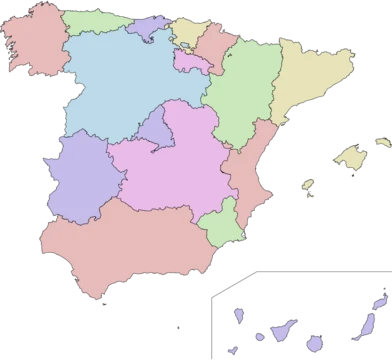
Extremadura
Landlocked Spanish autonomous community with rich wildlife and energy resources.

Extremadura is a landlocked autonomous community of Spain, located in the central-western part of the Iberian Peninsula. Its capital is Mérida, and its largest city is Badajoz. The region is crossed by the Tagus and Guadiana rivers and is formed by the provinces of Cáceres and Badajoz. It is an important area for wildlife, featuring the Monfragüe National Park and the International Tagus River Natural Park, and is at the forefront of Spain's plans for energy transition and decarbonisation due to its energy surplus and lithium deposits.
- capital
- Mérida
- largest_city
- Badajoz
- population
- Not specified in source
- government
- Regional Government led by President María Guardiola (People's Party)
- day_of_celebration
- 8 September (Day of Extremadura, coinciding with Our Lady of Guadalupe)
Lore & Background
During the Roman Empire, the area of Extremadura was part of the province of Lusitania, with Mérida as its capital. The territory was conquered by the Umayyads in the early 8th century and later became part of the Taifa of Badajoz after the collapse of the Caliphate of Córdoba. In the 11th and 12th centuries, the kingdoms of León, Castile, and Portugal made advances, though setbacks occurred due to Almoravid and Almohad campaigns. In the late Middle Ages, the territory consisted of mayorazgos of the military orders of Santiago and Alcántara, nobiliary lordships, and royal demesne towns.
Reader's Guide
Extremadura's significance lies in its historical role as a frontier region between Christian and Muslim Iberia, its Roman heritage centered on Mérida, and its modern importance as a wildlife haven and energy hub. The region's name likely derives from Latin 'Extrema Dorii' (areas south of the Duero) or from 'extremo' plus the suffix '-dura', referring to the outer regions of the kingdoms of León and Castile. Its geography, defined by the Tagus and Guadiana rivers and mountain ranges such as the Sistema Central and Sierra Morena, supports a climate that is predominantly hot-summer Mediterranean, with some semi-arid areas. The region's energy surplus and lithium deposits position it as a key player in Spain's energy transition. The Day of Extremadura on 8 September coincides with the Catholic festivity of Our Lady of Guadalupe. The regional government is currently led by President María Guardiola of the People's Party.
Did You Know?
- Extremadura is formed by the two largest provinces of Spain: Cáceres and Badajoz.
- The region's name may refer to the areas surrounding the south of the river Duero, from Latin 'Extrema Dorii'.
Landscape Shaped by Rivers and Ridges
Landlocked and bordered by Portugal to the west, Castile and León to the north, Castilla–La Mancha to the east, and Andalusia to the south, the region is divided into two of the country's largest provinces: Cáceres and Badajoz. Its capital, Mérida, sits in the north, while Badajoz holds the title of largest city. Two great rivers, the Tagus and the Guadiana, sweep eastward through the territory and carve the land into three distinct bands. From the Sistema Central in the north down to the Tagus lies the first zone; between the Tagus and Guadiana stretches the so-called Mesopotamia extremeña; and south of the Guadiana the land rises toward the Sierra Morena, which forms the boundary with Andalusia. Four hydrographic basins drain the region, though the Tagus and Guadiana catchments dominate by a wide margin. The climate is predominantly hot-summer Mediterranean, with scorching, rain-starved summers and precipitation concentrated in the colder months, producing intense seasonal water stress.
Layers of Conquest and Empire
Long before it bore the name Extremadura, the land was a crossroads of empires. Under Rome, the territory fell within the province of Lusitania, and Mérida rose to become its capital and one of the most significant urban centres in the entire Roman world. The Umayyad conquest of the early eighth century swept through the region, folding it into the Emirate and later the Caliphate of Córdoba, where it largely formed a territorial subdivision centred on Mérida. The collapse of the Caliphate in the early eleventh century, during the upheaval known as the Fitna of al-Andalus, shattered the political order. The bulk of what is now Extremadura coalesced into the First Taifa of Badajoz, a statelet founded by Sapur, a saqaliba slave previously freed by the Caliph Al-Hakam II. Meanwhile, the Christian kingdoms of León, Castile, and Portugal pressed southward and westward across the same territory in the eleventh and twelfth centuries. These competing claims layered the region with a complex heritage that still echoes in its place-names and cultural identity.
Wildlife and Natural Reserves
Extremadura's varied terrain and river systems have made it a refuge for wildlife of national and international significance. Along the western border, the International Tagus River Natural Park spans the river that separates Spain from Portugal, offering a transnational corridor for species that move freely between the two countries. The region's ecological richness is underpinned by its physical diversity. Further south, the Mesopotamia extremeña between the Tagus and Guadiana presents a drier, more open landscape, while the Sierra Morena in the far south introduces Mediterranean scrub and woodland. Four hydrographic basins—the Tagus, Guadiana, Guadalquivir, and Douro—thread through the territory, and the Tagus tributaries on the right bank carry substantial water volumes from the rain-rich, snow-laden slopes of the Sistema Central. This gradient of altitude, rainfall, and riverine habitat creates a mosaic of ecosystems that sustain a wide array of fauna across the region.
Identity, Governance, and the Energy Transition
Extremadura's modern identity is anchored in both tradition and forward-looking ambition. Each year on 8 September, the Day of Extremadura is observed, a date that coincides with the Catholic feast of Our Lady of Guadalupe, tying regional pride to a shared religious calendar. The region's name itself carries the weight of its peripheral position: derived either from the Latin Extrema Dorii, referring to lands south of the Duero, or from the Spanish word for 'extreme' combined with a suffix denoting the outer reaches of the kingdoms of León and Castilla. Politically, the autonomous community is governed by a president of the Regional Government, a post currently held by María Guardiola of the People's Party. Looking ahead, Extremadura occupies a pivotal role in Spain's broader energy strategy. The region boasts an enormous energy surplus and sits atop significant lithium deposits, placing it at the forefront of national plans for energy transition and decarbonisation. This combination of renewable output and critical mineral resources positions the landlocked community as a key player in the Iberian Peninsula's shift toward a low-carbon future.
Frequently Asked Questions
What is the capital of Extremadura, and how does it differ from the largest city?
Mérida holds the title of regional capital, while Badajoz is the most populous urban centre in the community. So the administrative seat and the biggest city are two different places.
Why does Extremadura matter for Spain's energy transition?
The region sits on substantial lithium deposits and already produces a surplus of renewable electricity, which puts it at the centre of national decarbonisation plans. Its combination of mineral wealth and clean-energy capacity makes it a strategic asset for the country's shift away from fossil fuels.
When is the Day of Extremadura, and why that date?
The community celebrates its anniversary on 8 September, a day that also marks the feast of Our Lady of Guadalupe, the patroness of the region. The two observances are deliberately merged into a single regional holiday.
What nature reserves is Extremadura famous for?
It is home to Monfragüe National Park and the International Tagus River Natural Park, both renowned for rich birdlife and broad biodiversity. Together they make the region one of Spain's most important wildlife corridors.
More in Regions Of Spain 1-21
Spotted an error? Know more?
This is a living reference — every entry is fact-audited, and reader corrections feed straight into our audit queue. Suggest an edit · See this site's audit record