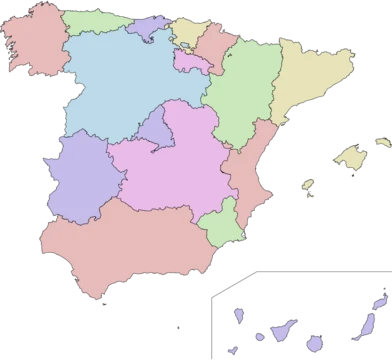
Valencian Community
Autonomous community on Spain's Mediterranean coast.

The Valencian Community is an autonomous community of Spain, located along the Mediterranean coast on the east side of the Iberian Peninsula. It is the fourth most populous Spanish autonomous community, with more than 5 million inhabitants, and its capital Valencia is the third-largest city and metropolitan area in Spain. The community is divided into three provinces: Castellón, Valencia, and Alicante. Official languages are Valencian (the official and traditional name used in the Valencian Community for the Romance language also known as Catalan) and Spanish. As of 2024, the population of the Valencian Community comprised 10.9% of the Spanish population.
- population
- more than 5 million (2024: 10.9% of Spanish population)
- capital
- Valencia
- official_languages
- Valencian (also known as Catalan) and Spanish
- established
- 1982 (current autonomous community under Generalitat Valenciana)
- historical_origin
- Kingdom of Valencia founded in 1238 by James the Conqueror
- area_division
- 3 provinces: Castellón, Valencia, Alicante
Lore & Background
The origins of the Valencian Community date back to the 1238 conquest by James the Conqueror of the Taifa of Valencia, establishing the Kingdom of Valencia as a component of the Crown of Aragon under the Furs of Valencia. The kingdom experienced a Golden Age in the 15th century, becoming the Crown's economic capital, with significant works like the chivalric romance Tirant lo Blanch and economic prosperity through the silk trade. Local institutions and laws continued during the early modern Spanish Monarchy but were suspended in 1707 after the War of the Spanish Succession via the Nova Planta decrees, which abolished the Kingdom of Valencia and forbade the use of Valencian in official instances and education. The Expulsion of the Moriscos in 1609 by the Hispanic Monarchy represented the loss of up to one third of the population of the Kingdom of Valencia and took the main agricultural labor force away.
Reader's Guide
The Valencian Community holds significance as a distinct historical nationality within Spain, with its own legal and administrative traditions dating from the medieval Kingdom of Valencia. Its modern autonomous status, established in 1982 after the Spanish Transition, resolved a naming conflict between 'Valencian Country' (associated with 19th-century nationalism and the Catalan Countries concept) and 'Former Kingdom of Valencia' (favored by anti-Catalan blaverists). The official name 'Valencian Community' is now accepted by the vast majority of Valencians. The community's cultural identity is shaped by its Romance language (Valencian/Catalan), its Mediterranean location, and a history that includes Roman foundation, Islamic rule, and a golden age of economic and cultural flourishing before decline following the Expulsion of the Moriscos in 1609 and the centralizing Bourbon reforms.
Did You Know?
- The city of Valencia was founded by the Romans in 138 BC under the name Valentia Edetanorum, meaning 'strength of the Edetani'.
- The Expulsion of the Moriscos in 1609 cost the Kingdom of Valencia up to one third of its population and its main agricultural labor force.
- The Valencian Community is commonly referred to affectionately as la Terreta, meaning 'The Little Land'.
- The 15th-century chivalric romance Tirant lo Blanch was produced during Valencia's Golden Age as the Crown of Aragon's economic capital.
- The official name 'Valencian Community' was adopted in 1982 as a compromise between 'Valencian Country' and 'Former Kingdom of Valencia'.
Geography & Demographics
The Valencian Community stretches along the eastern Mediterranean coastline of the Iberian Peninsula, bordered by Catalonia to the north, Aragon and Castilla–La Mancha to the west, Murcia to the south, and the Balearic Islands positioned offshore to the east. The region is organized into three provincial divisions: Castellón, Valencia, and Alicante. Its capital, Valencia, is the third-largest city and metropolitan area in the country. With more than five million residents, the community ranks as the fourth most populous autonomous region in Spain, behind only Andalusia, Catalonia, and the Community of Madrid. As of 2024, its inhabitants represent roughly 10.9 percent of the total Spanish population. The Mediterranean orientation and the long history of coastal settlement, from the Greek trading posts at Saguntum and Dianium to the Roman city of Valentia, have deeply shaped the region's character and identity.
From Roman Valentia to the Medieval Kingdom
Before Roman arrival, the land was inhabited by several Iberian peoples — the Contestani, Edetani, Ilercavones, and Bastetani — and Greek traders set up colonies at coastal sites such as Saguntum and Dianium in the fifth century BC. Carthaginian control followed the First Punic War, and Hannibal's razing of Saguntum in 219 BC ignited the Second Punic War, which ultimately folded the region into the Roman Empire. The Romans laid out Valentia in 138 BC, a settlement that over the centuries surpassed Saguntum in significance. After the Western Roman Empire fell, the Alans swept through and the Visigoths took rule until Arab forces arrived in 711, leaving a cultural imprint still legible in the modern landscape. The region's most consequential political moment came in 1238, when James the Conqueror seized the Taifa of Valencia and founded a new Kingdom of Valencia, complete with its own legal code, the Furs, and administrative institutions nested within the Crown of Aragon. The fifteenth century brought a Golden Age as Valencia became the Crown's economic capital.
Naming, Identity, and the Blaverist Debate
The very name of the region has long been a flashpoint for political and cultural identity. "Valencian Community" (Comunitat Valenciana) is the official title enshrined in the 1982 Statute of Autonomy, deliberately chosen as a neutral compromise. On one side stood "Valencian Country" (País Valencià), a term that carried the nationalist subtext of a modern Valencian nationality, resurgent in the nineteenth century, cemented during the Second Spanish Republic, and championed by writer Joan Fuster in the 1960s as part of the broader "Catalan Countries" (Països Catalans) concept. Anti-Catalan blaverists rejected that framing and pushed for "Former Kingdom of Valencia" (Antic Regne de València) to underscore cultural distinctiveness from Catalonia. In everyday life, residents often use the affectionate la Terreta, "The Little Land." Today, the vast majority of Valencians have settled on the official denomination, and no significant public dispute over the name persists.
Political Evolution and Modern Self-Government
The Valencian people are formally recognized in their Statute of Autonomy as a "historical nationality," a status traceable to the 1238 conquest and the independent legal and administrative framework of the medieval Kingdom of Valencia. Those local institutions and the Furs of Valencia survived the early modern dynastic union that created the unified Spanish Monarchy, but they were suspended in 1707 as a consequence of the Spanish War of Succession. Valencian nationalism re-emerged toward the close of the nineteenth century, crystallizing the modern conception of a distinct Valencian Country. After the democratic Transition, the current autonomous community was formally established in 1982, with the Generalitat Valenciana serving as its self-government institution. The region operates under two official languages: Valencian — the traditional local name for the Romance language also known as Catalan — and Spanish. This bilingual framework, combined with the self-governance structure, defines the political landscape of a community that now holds roughly 10.9% of Spain's total population.
Frequently Asked Questions
What is the Valencian Community?
It is an autonomous community stretching along Spain's eastern Mediterranean shoreline. With over five million residents, it ranks as the fourth most populous region in the country.
What languages are officially recognized in the Valencian Community?
The region grants official status to both Valencian (also referred to as Catalan) and Spanish.
How is the Valencian Community divided into provinces?
The community is split into three provinces: Castellón, Valencia, and Alicante.
When did the Valencian Community gain its current autonomous status?
The present-day autonomous structure under the Generalitat Valenciana took effect in 1982, building on a historical lineage that goes back to the Kingdom of Valencia established in 1238 by James the Conqueror.
What is the capital of the Valencian Community?
Valencia holds the capital title and is the third-largest city and metropolitan area in Spain.
More in Regions Of Spain 1-21
Spotted an error? Know more?
This is a living reference — every entry is fact-audited, and reader corrections feed straight into our audit queue. Suggest an edit · See this site's audit record