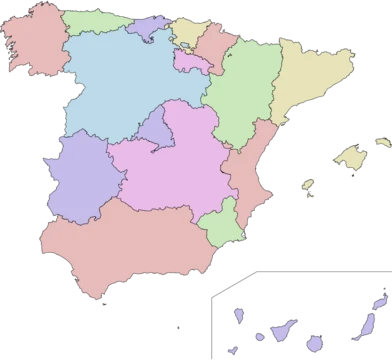
La Rioja
Spain's least populated autonomous community, famed for its Denominación de Origen Calificada Rioja wine.

La Rioja is an autonomous community and province in northern Spain, on the Iberian Peninsula. Its capital is Logroño. Other cities and towns in the province include Calahorra, Arnedo, Alfaro, Haro, Santo Domingo de la Calzada, and Nájera. As of 2024, it had a population of 324,184, making it the least populated autonomous community of Spain. It covers part of the Ebro valley towards its north and the Iberian Range in the south. The community is a single province, so there is no provincial deputation, and it is organized into 174 municipalities. The region is well known for its wines under the brand Denominación de Origen Calificada Rioja.
- Capital
- Logroño
- Population (2024)
- 324,184
- Area
- Single province, 174 municipalities
- Autonomous community status
- 1982
- Known for
- Rioja wine
- Borders
- Basque Country, Navarre, Aragón, Castilla y León
Verified Timeline
Lore & Background
The area was once occupied by pre-Roman Berones, Pellendones and Vascones. After partial recapture from the Muslims in the early tenth century, the region became part of the Kingdom of Pamplona, later being incorporated into Castile after a century and a half of disputes. The name 'Rioja' (from Río Oja) is first attested in 1099. From the eighteenth century the Rioja region remained divided between the provinces of Burgos and Soria, until in 1833 the province of Logroño was created, changing the name of the province to La Rioja in 1980 as a prelude to its constitution under a single provincial autonomous community in 1982.
Reader's Guide
La Rioja's significance lies in its historical role as a contested borderland between the kingdoms of Pamplona, Navarre, and Castile, and its later consolidation into a single province and autonomous community. The region's wine production under the Denominación de Origen Calificada Rioja has given it international renown. The etymology of the toponym is disputed, with theories linking it to the river Oja, the Latin term Rivalia, or Basque origins. The territory was part of the Roman province of Hispania Tarraconensis and later the Visigothic Duchy of Cantabria. After Muslim rule, most of it was reconquered in 923 by Sancho I of Pamplona. The Camino de Santiago pilgrimage route crossed the Ebro at Logroño's Puente de Piedra, adding to its medieval importance. Today, La Rioja is the second-smallest autonomous community in Spain and has the smallest population, with nearly half of its citizens living in the capital.
Did You Know?
- The name 'Rioja' is first attested in 1099, in the Miranda de Ebro charter.
- La Rioja briefly formed the independent Kingdom of Viguera from 970 to about 1005.
- The region's highest peak is Monte San Lorenzo at 2,271 m.
- The demonym 'Riojan' (Spanish: riojano) is attested from the 13th century, with the spellings riogeñ and riogensi.
- Nearly half of La Rioja's citizens live in the capital, Logroño.
Geography & Demographics
La Rioja occupies a compact stretch of northern Iberia, straddling two distinct landscapes: the fertile Ebro valley to the north and the rugged Iberian Range to the south. As both an autonomous community and a single province, it contains no provincial deputation and is subdivided into 174 municipalities. Its capital, Logroño, anchors a network of smaller towns including Calahorra, Arnedo, Alfaro, Haro, Santo Domingo de la Calzada, and Nájera. With a 2024 population of 324,184, it stands as the least populated autonomous community in all of Spain. The region's borders are well defined: the Basque Country (province of Álava) to the north, Navarre to the northeast, Aragón (province of Zaragoza) to the southeast, and Castilla y León (provinces of Burgos and Soria) to the west and south. The river Ebro flows through the north of the community, as does the river Oja, after which it is named. The climate is mainly continental, with the Rioja Alta comarca receiving more precipitation than Rioja Baja. The average temperature ranges from 11.8 to 31.8 °C and the precipitation ranges between 300 and 500 mm as an annual average. The wind called Cierzo is very frequent during the winter.
Medieval Political Struggles
For centuries, La Rioja was a contested frontier rather than a stable polity. After the Muslim invasion of 711 placed the territory under Al Andalus, most of it was reconquered in 923 by Sancho I of Pamplona, acting for the Kingdom of Pamplona together with the Kingdom of León and the Counts of Castile. The lower region around Arnedo came under control of his allies the Banu Qasi of Tudela, and the territory east of the Leza River remained under Muslim control. The region then became a flashpoint between Castile and Navarre. A bitter dispute between Count Fernán González of Castile and the kings of Pamplona-Navarra was decided in favour of the Navarrese after the imprisonment of the Count's family in Cirueña in 960. From 970 to about 1005, La Rioja briefly existed as the independent Kingdom of Viguera before rejoining the Kingdom of Pamplona. Sancho Garcés moved the capital of the Kingdom of Pamplona to Nájera, creating the so-called kingdom of Nájera-Pamplona which was, due to its large size, the first Spanish Empire. After Castile's independence in 1035, this new kingdom fiercely fought against Pamplona for the possession of Bureba, La Rioja and other territories. In 1076, after the murder of Sancho IV, Navarre was divided among Castile and Aragon, and Castile obtained La Rioja. The final settlement came in 1177, when the region was awarded to Castile in a judgement by Henry II of England and annexed. Logroño, a perpetually disputed borderland between the kings of Navarre and the kings of Castile from the 10th century, sat at the heart of these struggles, and the Camino de Santiago crossed the Ebro there via the Puente de Piedra.
Etymology & the Evolution of the Name
The name Rioja has generated centuries of scholarly debate. The most popular theory links it to the river Oja, though other proposals suggest a Latin root in Rivalia meaning 'land of streams', a tautological phrase rivo Ohia meaning 'river of fluvial bed', or even a Basque-language origin combining herria and ogia to yield 'land of bread'. Scholars from the sixteenth-century Florián de Ocampo through the eighteenth-century friar Mateo Anguiano, the nineteenth-century Ángel Casimiro de Govantes, and twentieth-century linguists Menéndez Pidal and Merino Urrutia have all weighed in, with researcher Eduardo Aznar Martínez continuing the discussion into the twenty-first century. The toponym first appears in writing in the 11th century as Rioga or Riogam, later shifting through spellings like Rioxa, Riogia, Rivo de Oia, and Rivogio before settling on Rioja. The demonym Riojan is attested from the 13th century as riogeñ or riogensi. Crucially, the earliest references designate only the westernmost area around the Tirón and Oja river basins; the name gradually expanded across the Middle Ages to encompass the seven valleys stretching from the Tirón in the west to the Alhama in the east, all feeding into the Ebro.
Modern Administrative Evolution & Identity
For much of the eighteenth century, the territory now known as La Rioja was administratively split between the intendences of Burgos and Soria, denying it a unified political identity. The region was taken by Napoleonic forces in the Peninsular War and remained solidly in French hands until 1814. The Cortes of Cádiz declared La Rioja an independent province at the time of the Liberal Constitution of 1812, and during the Liberal Triennium in January 1822 the province of Logroño was created by royal decree, taking in the whole of the historical territory of La Rioja. However, Ferdinand VII soon annulled these decisions. In the 1833 reorganization, a province of Logroño was again formed within the region of Castilla la Vieja. The province increased its territory temporarily in 1841. The name La Rioja did not officially replace Logroño until 1980, a deliberate step that preceded the community's full constitution as a single-province autonomous community in 1982 following the adoption of the Estatuto de San Millán. This modern arrangement means La Rioja has no provincial deputation; its 174 municipalities operate directly under the autonomous government. Today, La Rioja's most globally recognized identity is its wine: the Denominación de Origen Calificada Rioja brand has made the region synonymous with viticulture on the world stage, a reputation that transcends its modest population of 324,184.
Frequently Asked Questions
What is La Rioja?
La Rioja is an autonomous community and single-province region in northern Spain on the Iberian Peninsula. It achieved autonomous community status in 1982 and is divided into 174 municipalities.
What is the capital of La Rioja?
Logroño serves as the capital city, anchoring the region's administrative, cultural, and economic life.
Why is La Rioja so well known?
The region is internationally celebrated for its wine, produced under the Denominación de Origen Calificada Rioja label, widely regarded as one of the most prestigious wine designations in the world.
How many people live in La Rioja?
As of 2024, the region had a population of roughly 324,184 residents, making it one of the least populated autonomous communities in Spain.
Which regions border La Rioja?
La Rioja shares borders with four neighboring territories: the Basque Country and Navarre to the north, Aragón to the east, and Castilla y León to the south and west.
More in Regions Of Spain 1-21
Related in Regions Of Spain
Links follow this subject's own source article.
Spotted an error? Know more?
This is a living reference — every entry is fact-audited, and reader corrections feed straight into our audit queue. Suggest an edit · See this site's audit record